Most people who come to us describing “bad sleep” are not doing anything obviously wrong. They go to bed at a reasonable hour. They are tired. They still lie there, watching the clock, doing the arithmetic of how many hours are left before the alarm.
That gap — between being tired and being able to sleep — is the thing worth understanding, because it is rarely about willpower and almost never fixed by trying harder. Sleep is not a switch you flip. It is a process you set up conditions for, and then leave alone.
This guide covers three things: what normal sleep actually looks like (so you stop measuring yourself against an unrealistic target), the practical habits that genuinely move the needle, and the structured approach — CBT‑I — that clinical guidance treats as the first-line way to rebuild sleep that has come apart.
First: your idea of “normal sleep” is probably wrong
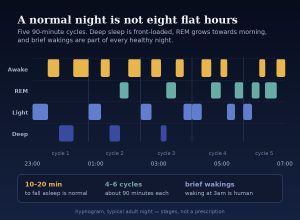
A healthy night is not eight uninterrupted hours. It looks more like this:
- Cycles of roughly 90 minutes, four to six of them, moving through lighter and deeper stages.
- Brief awakenings — several per night, most of them so short you don’t remember them.
- A natural wake-up somewhere between 6 and 9 hours after sleep onset, depending on your age and chronotype.
- A slow drift, not a drop. Sleep onset commonly takes 10 to 20 minutes.
Two implications follow. First, waking at 3am is not evidence of a disorder — it is evidence you are human. Second, if you respond to a normal awakening with alarm (“this again, tomorrow will be ruined”), that reaction is what converts a two-minute awakening into a ninety-minute one. The worry is the mechanism, not the waking.
Adults need somewhere between 7 and 9 hours, and the range is real. Some people genuinely run on less. Very few run on five.
Why sleep comes apart: the three-part pattern
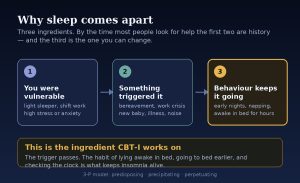
Sleep problems usually need three ingredients, and only one of them is the thing you think caused it.
- Something that made you vulnerable. A naturally light sleep pattern, shift work, a period of high stress, a tendency to anxiety.
- Something that triggered it. A bereavement, a difficult project, a new baby, a noisy neighbour, jet lag, an illness.
- Something that keeps it going after the trigger has passed. This is the part that matters, and it is nearly always behavioural: going to bed early to “catch up”, napping through the afternoon, lying in bed awake and frustrated for hours, checking the clock, cutting back on exercise because you’re too tired.
By the time most people look for help, the original trigger is long gone and they are stuck with ingredient three. That is good news, because ingredient three is the part you can actually change — and it is exactly what CBT‑I targets.
Sleep hygiene: the habits that really matter
Sleep hygiene gets dismissed because it is presented as a long list of small rules. In practice, four of them carry most of the benefit.
Light is the master signal. Your body clock sets itself mainly by light, especially light in the first hour after waking and the absence of it in the last two hours before bed.
- Get outside within an hour of waking, even on a grey day. Outdoor light is many times brighter than indoor light.
- Dim the room in the final hour before bed. Lamps, not ceiling lights.
- Keep screens out of the last 30 minutes where you can, or at least drop brightness hard and stop anything that makes you think.
Consistency beats duration. A fixed wake-up time, seven days a week, does more for sleep than any amount of early nights. The wake time anchors the clock; bedtime then follows naturally. Yes, weekends too — within about an hour.
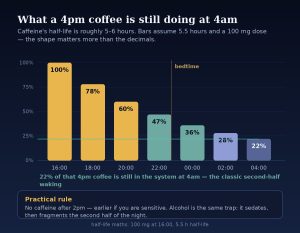
Caffeine has a long tail. Its half-life is roughly five to six hours, so a 4pm coffee still has a quarter of its punch at 10pm. Cut-off at 2pm, earlier if you are sensitive.
Alcohol is the great sleep fraud. It sedates you rather than sleeping you. It shortens the time to sleep onset, then fragments the second half of the night and suppresses the deeper stages. Many people who describe “waking at 3am every night” are describing alcohol metabolism.
Others worth keeping, in order of usefulness: cool room (around 16–18°C), dark room, no long naps after 3pm (20 minutes maximum), and vigorous exercise somewhere in the day — but not in the two hours before bed.
The bed rule that changes everything
This is the single most powerful behavioural instruction in sleep work, and it is one sentence:
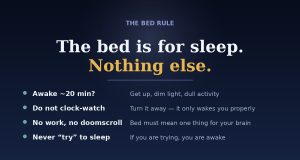
The bed is for sleep. Nothing else.
If you are awake for what feels like more than about 20 minutes — and you should be guessing, not clock-watching — get up. Go to another room, keep the lights low, do something dull and unstimulating (read something unexciting, fold laundry), and go back only when you feel sleepy. Repeat as often as needed.
This feels counterproductive the first few nights. It is not. What you are doing is breaking a learned association. If your brain has spent three months learning that bed equals frustration and alertness, no amount of lying there will unlearn it. Getting up is how you teach the opposite association: bed equals sleep.
Rules that go with it:
- Do not use the bedroom for work, arguments, or doomscrolling.
- Do not check the time during the night. Turn the clock away. The time tells you nothing useful and reliably wakes you up properly.
- Do not “try” to sleep. Effort is the enemy here. If you are trying, you are by definition awake.
CBT‑I, in plain terms
Cognitive Behavioural Therapy for Insomnia is the structured, evidence-based version of everything above. Clinical guidance treats it as the first-line approach for chronic insomnia — ahead of anything you swallow. It has four components:
- Sleep restriction (better named sleep compression). You temporarily narrow your time in bed to roughly your actual sleep time, then extend it back as sleep consolidates. This sounds like the last thing a tired person wants; it is also the component with the strongest effect, because it rebuilds “sleep pressure” — the natural drive that accumulates the longer you are awake. Do this as a guided step, not from an article, and not at all if you drive long distances or operate machinery on little sleep.
- Stimulus control. The bed rule above, formalised.
- Cognitive work. Handling the beliefs that keep the cycle turning: “I must get eight hours”, “I will fail tomorrow”, “I will never sleep properly again”. These thoughts are not harmless — they generate arousal at exactly the moment you need the opposite.
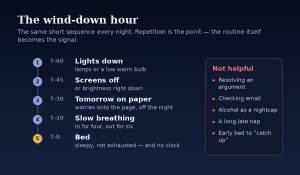
- Not to force sleep, but to lower the baseline activation that keeps you alert in bed. Slow breathing — in for four, out for six, ten minutes — is the simplest version that works.
The typical course is four to eight sessions, delivered one-to-one, in a group, or digitally, and it is the approach with the most durable results: unlike sleep aids, the improvement tends to stay after the treatment stops. In the UK it is available through your GP and through NHS Talking Therapies, and several evidence-based digital programmes exist.

A 14-day reset you can start tonight
Do not attempt all of this at once. Pick the first two items and hold them for the full fortnight.
Days 1–3 — set the anchor
- Choose one wake-up time. Set it for all 14 days.
- Get outside within an hour of waking for at least 10 minutes.
- Write down (briefly) what time you went to bed, when you think you fell asleep, and how many times you woke. Two lines. That is a sleep diary, and it is the single most useful thing you can bring to a clinician later.
Days 4–7 — reclaim the bed
- Apply the bed rule: up after roughly 20 minutes awake, return only when sleepy.
- Move the clock out of sight.
- Cut caffeine after 2pm. Cut alcohol entirely for the fortnight and see what the second half of your night does.
Days 8–11 — protect the wind-down
- Last hour: dim lights, no work, no news, no arguments.
- Same 20–30 minute sequence every night — shower, tidy, reading, breathing. Repetition is the point; the sequence becomes the signal.
- Write tomorrow’s worries on paper before bed. Offloading them onto a page reduces bedtime rumination more reliably than resolving them in your head.
Days 12–14 — review and adjust
- Read your diary back. Are you sleeping more, or just lying in bed more? If the latter, shorten time in bed by 30 minutes.
- If you are falling asleep quickly and staying asleep, extend bedtime by 15 minutes.
Where to expect the change: sleep onset usually improves first, night-time wakings second, and the daytime feeling of “refreshed” last. That order surprises people. Give it three to four weeks before judging it.
Stress and sleep feed each other — break it from the sleep side
You will not fix a stressful period by fixing your sleep, but you can stop the two making each other worse. The most useful move is to stop treating the night as the time you deal with the day.
- Schedule worrying. Twenty minutes, in the early evening, on paper. Outside that window, if a worry arrives at 2am, you write it down for tomorrow’s session rather than working through it in the dark.
- Do not build your day around being tired. Cancelling the walk, the gym, the seeing-people — that removes the very things that build sleep pressure and lift mood.
- Keep one anchor of normality. Same wake time, one outdoor walk, one meal at a proper table. Three anchors hold a bad patch together.
- Shorten the fight. Ten minutes of slow breathing when you get into bed, then let it go. If it isn’t happening, get up, as above.
Common myths, quickly
- “I must get eight hours.” You must get enough for you, consistently. That may be seven.
- “A nightcap helps.” It puts you under and then wakes you at 3am.
- “I’ll catch up at the weekend.” You partly can, and it also shifts your clock and makes Monday worse.
- “Lying quietly is nearly as good as sleeping.” Rest has value. It does not replace sleep, and hours spent awake in bed actively train the wrong association.
- “Nothing works for me.” Structured CBT‑I outperforms everything else for chronic insomnia. What usually fails is trying one technique for four nights and stopping.
When to get help rather than read more
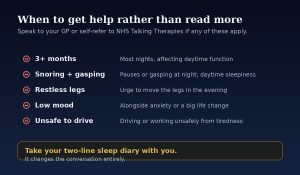
Speak to your GP or self-refer to NHS Talking Therapies if any of the following apply:
- Poor sleep on most nights for more than three months, affecting your daytime functioning
- Loud snoring with pauses, gasping, or heavy daytime sleepiness (this needs proper assessment, not a sleep-hygiene article)
- Legs that jerk or an irresistible urge to move them in the evening
- Sleep problems alongside low mood, anxiety, or a significant life change
- You are driving or working unsafely because of tiredness
Take your two-line diary with you. It changes the conversation entirely.
Sleep responds to structure, light, timing, and a bed that means one thing. None of it is dramatic. All of it works, and most of it you can start tonight.
____________________________________________________________
FAQ (for schema markup)
How long should it take to fall asleep? Ten to twenty minutes is normal. Consistently under five minutes usually means you are significantly sleep-deprived.
Is waking up at 3am every night normal? Waking briefly is normal. Being fully alert at the same time nightly often reflects alcohol, an irregular wake time, or a stress response — all of which respond to the changes above.
Does CBT‑I work? Yes. It is the recommended first-line treatment for chronic insomnia and its benefits tend to persist after the course ends, unlike sleep aids.
How long until sleep hygiene helps? Sleep onset often improves within two weeks; feeling genuinely restored usually takes three to four.
Should I nap? If you must, 20 minutes, before 3pm. Long or late naps reduce the sleep pressure you need at night.